| | by admin | | posted on 13th March 2025 | | views 723 | |
St Wulfram's Church & its library
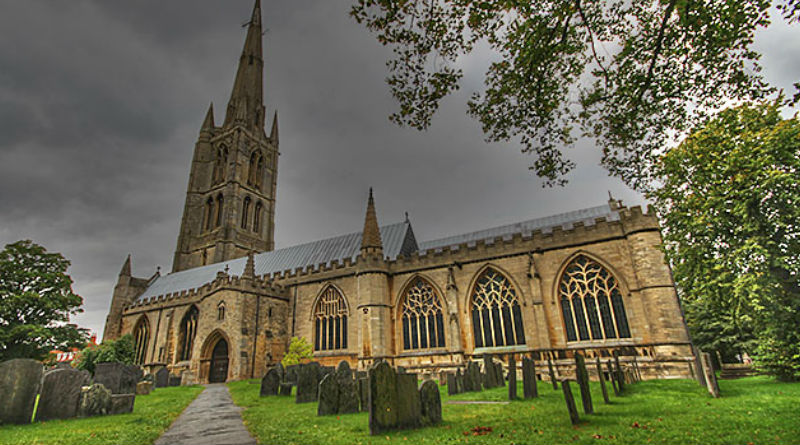
St Wulfram’s Church in Grantham is more like a mini-cathedral than a parish church.
One of the very best historical churches in the country
In his popular book, England’s Thousand Best Churches, author Simon Jenkins awards St Wulfram’s Church in Grantham, Lincolnshire, a five-star rating, marking it as one of the very best historical churches in the country.
It is easy to see why Jenkins was so impressed when you visit this remarkable historic building. The glory of St Wulfram’s is the soaring spire that rises 283 feet above the ground. It was the tallest spire in the country at the time it was built.
The earliest church on this site was built in the early Saxon period, and a church was recorded in the Domesday Book of 1086. You can still see Saxon herringbone stonework near the organ.
The Saxon church was rebuilt in the Norman period, and rebuilt again after a fire in 1222, giving us the core of the building we see today. It is constructed of limestone quarried at nearby Ancaster.
The church has been a Grade I listed building since 8 May 1950.
Francis Trigge Chained Library
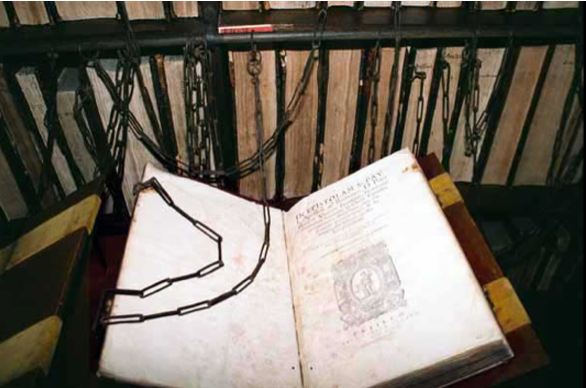
Arguably Britain’s first public library, the Francis Trigge Chained Library is located in the upper south porch of St Wulfram’s Church, accessed via a steep twisting staircase. The library was created in 1598 when Francis Trigge, the rector at nearby Leadenham, donated ‘one hundred poundes or thereaboutes’ for:
“The better encreasinge of learnings and knowledge in divinitie & other liberall sciences & learning by such of the cleargie & others as well as beinge inhabitantes in or near Grantham & the soake thereof as in other places in the said Countie.”
Purchased mainly from Cambridge, and because books were such a precious commodity at the time, they were chained together to prevent theft. An inventory dating from 1608 lists 228 titles — the majority on religious topics, but also including natural history and medicine. As of today, there are 338 books catalogued in the library.
The library’s earliest book was published in Venice in 1472 — just a couple of decades after Gutenberg had invented the printing press. There is also a miniature (literally an inch long) book of the Life of Christ.
Although the library was not open to the general public, it was freely accessible to The King’s School, Grantham, and other interested groups. Therefore, because of its usage in the local community, the library is classed not as a private collection but as a public library — and may well be Britain’s first.
Leave a comment
Our mission
Lincolnshire Radical History documents the people, places, and movements where Lincolnshire’s history of dissent continues into modern activism.
Hosted by

Upcoming Events
Lincoln Festival of History
(May Bank Holiday)
Local History Festival
(throughout May)
Heritage Open Days
(June–September)